


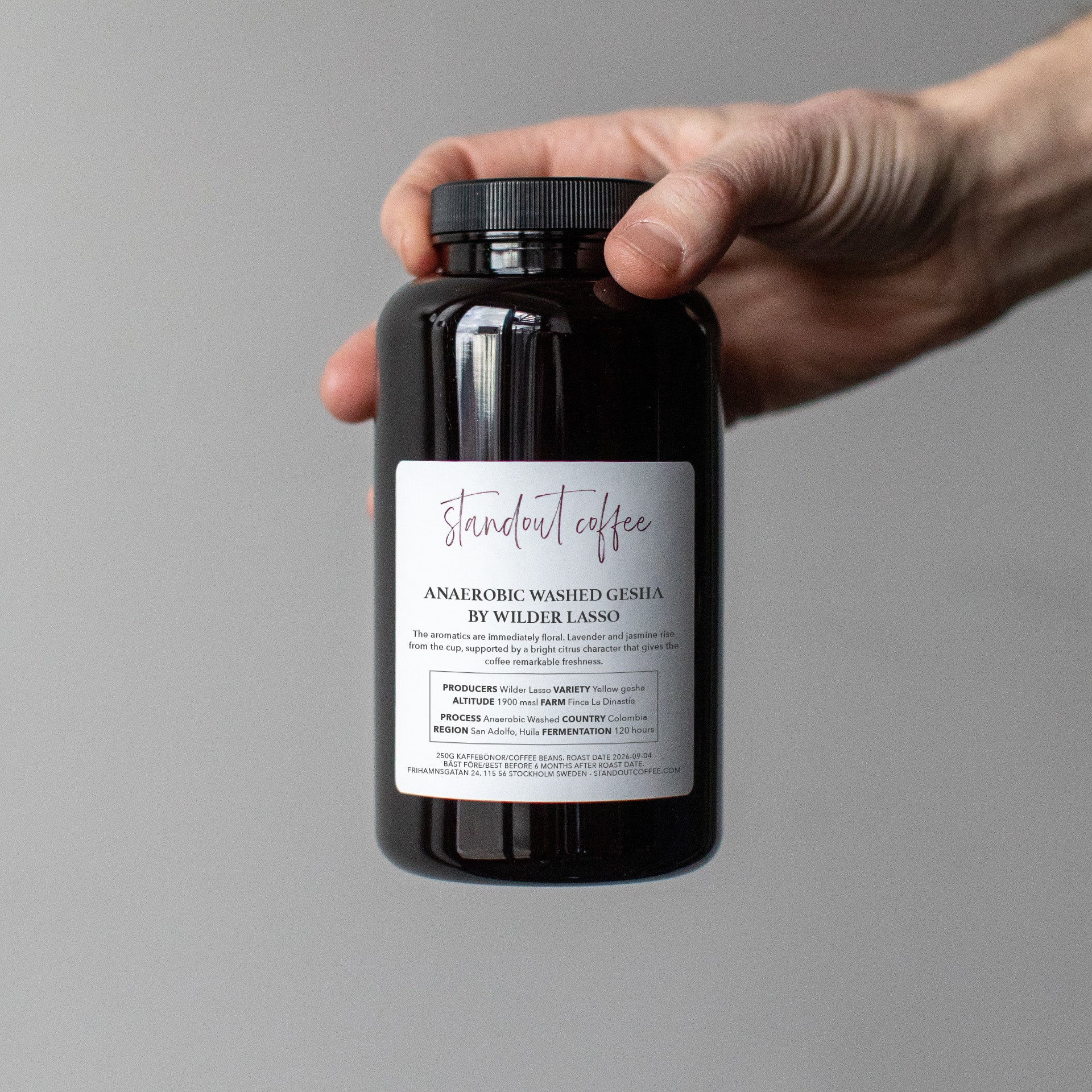
Wilder Lasso Yellow Gesha Finca La Dinastía Colombia
- Regular price
-
429 kr - Regular price
-
- Sale price
-
429 kr
Couldn't load pickup availability
Why we selected it
Five days of anaerobic fermentation sounds intensive.
This coffee doesn’t taste that way.
That is precisely why we selected it.
Wilder Lasso has managed to use a 120-hour fermentation to build aromatic intensity and sweetness while preserving the qualities we value most in Gesha: florality, transparency and precision.
Lavender and jasmine lead the cup, followed by delicate citrus, honeydew melon and white honey. It is expressive without becoming excessive.
For us, this is controlled fermentation at its best.
The process amplifies the coffee. It doesn’t replace it.
Why this coffee is significant
There is another reason we find this coffee particularly compelling.
Wilder’s work at Finca La Dinastía begins long before fermentation. After returning to his family farm in San Adolfo, Huila, he began questioning why considerable work in processing was still producing coffees scoring around 80–83 points.
His attention turned to the plants themselves.
Drawing on his background as a veterinarian and in livestock farming, Wilder began analysing soil, adjusting pH and applying nutrients according to the individual needs of the coffee plants.
He calls the approach precision agriculture.
The principle is simple: create the potential for exceptional coffee on the tree before attempting to shape it through processing.
This Yellow Gesha is one of the clearest expressions we have tasted of that philosophy.
The cup experience
The aromatics are immediately floral.
Lavender and jasmine rise from the cup, supported by a bright citrus character that gives the coffee remarkable freshness.
As it cools, the profile becomes softer and sweeter. Honeydew melon and white honey emerge, bringing a delicate tropical quality without compromising the clarity of the Gesha.
The texture is silky, the acidity bright and precise, and the finish long, floral and exceptionally clean.
It is a Gesha with intensity, but also restraint.
Producer and place
Wilder Lasso didn’t originally intend to become a coffee producer. He returned his attention to the family farm when his father became seriously ill and falling coffee prices were placing increasing pressure on the business. Today, Finca La Dinastía has become known for a very different approach.
At approximately 1,900 metres above sea level in San Adolfo, Huila, Wilder and the Lasso family work with expressive varieties including Gesha and Chiroso, combining agronomy, selective harvesting and carefully controlled fermentation.
Rather than treating processing as the primary source of flavour, Wilder works from the plant outward. That distinction matters.
Processing and its effect on the cup
Only fully ripe, exceptionally large cherries are selected before careful sorting and depulping. The coffee is then placed into sealed tanks for an extended 120-hour anaerobic fermentation. After fermentation, it is fully washed and slowly dried in marquesinas for approximately twelve days.
Five days is a considerable fermentation.
Yet the resulting cup remains remarkably transparent.
The anaerobic stage develops sweetness and aromatic intensity, bringing forward the melon, honey and floral character without introducing the heavy fermented flavours that can dominate coffees processed this way.
The result tells us as much about Wilder’s restraint as it does his experimentation.
How we brew it — Double Bloom
For this Yellow Gesha, we want the brewing to preserve its floral aromatics while giving the honeydew and white honey sweetness enough room to develop.
15 g coffee · 250 g water
Water: 93°C
Grind: Medium-fine
0:00–0:10: Pour 50 g
0:30–0:40: Pour another 50 g
1:00–1:10: Pour the remaining 150 g
Target brew time: 2:40–2:55
Allow the coffee to cool before judging the cup. The floral character appears immediately, but the deeper melon and honey sweetness becomes considerably more pronounced as the temperature falls.
Why this recipe suits the coffee
We use a relatively high brewing temperature to bring sufficient extraction and sweetness from this light, high-altitude Gesha.
The two 50 g blooms give the coffee a controlled start before the larger final pour. For this lot, we are looking for separation rather than weight: lavender and jasmine first, citrus through the centre, then honeydew and white honey as the cup cools.
We would avoid pushing the brew much beyond three minutes. The beauty of this coffee is its precision.
Our recommendation
This is a coffee for anyone interested in where modern Colombian Gesha is heading. Not because the fermentation is long, but because you barely notice that it is. Wilder has taken an inherently expressive variety, built exceptional raw material through precision agriculture, and then used fermentation with enough control to reveal more of what was already there.
Floral. Silky. Tropical. Exceptionally composed.
A Colombian Gesha shaped through precision.
Coffee details
Producer: Wilder Lasso
Farm: Finca La Dinastía
Region: San Adolfo, Huila, Colombia
Altitude: 1,900 m.a.s.l.
Variety: Yellow Gesha
Process: Anaerobic Washed
Fermentation: 120 hours
Drying: Marquesinas · approximately 12 days
Shipping information
- No EU import duties.
- Ships within 1-2 business days.
- Fully Tracked deliveries on all order.
- UPS and DHL available


Collections


“Standout Coffee operates at a level most roasteries talk about but rarely reach. The precision in their roasting is obvious from the first sip”
– Pierre V
FAQs
Amount of coffee
The Jar: Contains 250 grams of fresh roasted specialty coffee beans.
The Box: Contains 100 grams grams of whole competition style coffee beans.
The Big Bag: Contains 1000 grams of fresh roasted specialty coffee beans.
The Capsule box: Contains 10/50 biodegradable Nespresso compatible coffee capsules.
Roast Philosophy
Our coffees are roasted to shine both as filter brews and as competition-style espresso. They sit right in the sweet spot between specialty and competition coffees – clean, expressive, and precise.
If you’re a coffee bar or a private customer interested in learning more about our roast philosophy, or if you’d like something custom roasted for you and your clients, just leave us a note in the comments during checkout. We’ll be happy to get in touch.
How to brew
The Double Bloom | 15 g coffee/250 g water
⏱ 0:00-0:10 | 50 grams
⏱ 0:30-0:40 | 50 grams
⏱ 1:00-1:10 | 150 grams
Brew time for this recipe should be between 2:40-3:00!
Regarding extraction, this recipe results in a TDS value of 1,35 ≈ 20,5 % extraction.
Download our FREE V60 brew guide, The Double Bloom Recipe here: PDF or ePUB
Shipping with DHL Express Globemail
For international shipping: Once DHL Express has shipped your coffee out of Sweden they hand it over to the destination country's national post service.
If you have special delivery instructions or requests, please leave a note in your cart before checkout.